Semi-permanent water-based release agents for moulding

Semi-permanent water-based release agents are release products designed to ensure effective, clean and consistent demoulding in industrial moulding processes. Unlike traditional release agents, they allow multiple production cycles with a single application, reducing downtime and improving overall efficiency.

This type of release agent is particularly suitable for applications where high surface quality, reduced transfer to the workpiece and greater mould cleanliness are required.

Our products

Our semi-permanent water-based release agents

Our range includes professional solutions designed to deliver high performance in industrial processes. Each product is engineered to meet specific moulding needs, ensuring reliability and production continuity.

Uniform release
Long-lasting release film
Adaptable to different operating conditions

Semi-Permanent Water-Based Rubber Release Agents

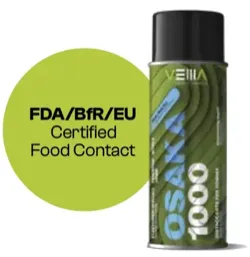
OSAKA 1000 FDA VEMA Chemical

OSAKA 1000 FDA

NEW 2026 FDA

FOOD Contact certified release agent for the molding of FKM / NBR / NITRILE / SPECIAL COMPOUNDS

  • FDA/BfR/EU Food Contact certified
  • Semi-permanent water-based technology
  • Ideal for FKM NBR Nitrile and Special Elastomers
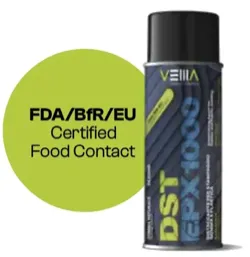
DST EPX 1000 FDA VEMA Chemical

DST EPX 1000 FDA

NEW 2026 FDA

FOOD Contact certified release agent for SILICONE RUBBER / NATURAL RUBBER

  • FDA/BfR/EU Food Contact certified
  • Semi-permanent water-based technology
  • Ideal for Silicone Rubber and Natural Rubber
Benefits

Benefits of semi-permanent water-based release agents

Semi-permanent water-based release agents offer numerous benefits in industrial moulding processes, especially in terms of cleanliness and sustainability.

They deliver uniform, consistent release, reducing residue build-up on the mould and improving the surface quality of the moulded part. They also enable multiple production cycles per application, increasing operational efficiency.

The water-based formulation makes them particularly suitable for production environments where high safety standards and reduced environmental impact are required.

Differences

Water-based vs solvent-based

The choice between water-based and solvent-based semi-permanent release agents depends on process requirements, environmental standards and the characteristics of the moulded part.

Water-based

A modern and sustainable solution, ideal for production environments with high safety standards and reduced environmental impact. Longer drying times but uniform release and excellent mould cleanliness.

Solvent-based

Fast drying and excellent film-forming capability, suitable for high-productivity processes. They require greater attention to environmental and workplace safety considerations.

Where compatibility with specific regulations is required (food sector, controlled environments), water-based formulations are the most appropriate choice.

Applications

When to use water-based release agents

Water-based release agents are recommended for continuous production processes, where it is essential to keep mould surfaces clean and ensure uniformity over time. They are particularly used in applications requiring high surface quality and compatibility with specific regulations, such as the food sector or controlled environments.

  • Plastic moulding
  • Rubber and elastomer processing
  • Food sector and controlled environments
  • Continuous production cycles
  • Technical components and composites
Definition

What are semi-permanent water-based release agents

Formulations developed to create a stable barrier between mould and processed material, with a water carrier to reduce environmental impact and improve workplace safety.

This barrier prevents part adhesion, facilitating demoulding and ensuring consistent results over time, even on complex geometries.

Compared to traditional solutions, semi-permanent release agents reduce application frequency, increasing productivity and improving process quality.

How to choose the right semi-permanent water-based release agent

Choosing the most suitable semi-permanent water-based release agent depends on several technical factors related to the material, the production process and the operating conditions. A careful evaluation ensures consistent performance over time and maximises production efficiency.

Material
Type of material processed — rubber, plastic, composites, polyurethane — which determines the optimal release agent formulation to ensure uniform release and surface quality.
Temperature and process conditions
Operating temperature, pressure and cycle time affect water-based release agent performance. In high-temperature processes it is essential to choose stable, resistant formulations.
Environmental and safety standards
In environments with high safety requirements, food sector or controlled environments, the water-based formulation is preferable for reduced environmental impact and greater operator safety.
Production continuity
Semi-permanent release agents enable multiple production cycles per application. Cycle frequency, film durability and the need to minimise machine downtime should be evaluated.
Mould geometry
Geometry, surface finish and part complexity determine the optimal formulation. Moulds with critical details require release agents that ensure uniform release even in challenging areas.

A careful technical evaluation of these factors makes it possible to identify the most suitable semi-permanent water-based release agent, ensuring consistent quality, production efficiency and compliance with environmental standards.

Technical support

We offer technical support to identify the most suitable semi-permanent water-based release agent for your application. Contact us for personalised consultancy.

Contact us